Wash Your Hands First a communal dinner a place for discussion examining the relationships between local communities and their role in creating access to the arts Each host has taken time out to prepare a special main dish, create a theme, set the table, light a candle, and wait for their guest to arrive.
Thursday, February 5, 2026
30 WONDERFUL Gullah Geechee Dishes Grandma Never Wrote Down
Sunday, December 10, 2023
CURRIED OXTAILS
The deep, rich flavors of a traditional spice paste fortified with curry leaves and curry powder are beautifully combined with the hearty taste of slowly stewed oxtails. Serve with rice or lontong (an Indonesian traditional rice dish), and a little Pickled Fruit Salad or Mango Sambal on the side.
SPICE PASTE
1-inch piece of ginger
1 stalk lemongrass
1 medium onion coarsely chopped.
6 cloves garlic
2 fresh red or green jalapeno chilies, seeded.
1 tablespoon chili garlic sauce
1/4 cup of water
1 medium potato
1 medium carrot
1/2 small jicama
2 pounds oxtail, cut into segments.
2 tablespoons cooking oil.
2 tablespoons curry powder
2 cinnamon sticks
10 dried curry leaves (optional)
1 can (13 ½ oz.) unsweetened coconut milk
3 cups water
¼ cup soy sauce
1 tablespoon packed brown sugar.
Mint leaves
Getting Ready
1.
Thinly slice ginger and bottom 6 inches of lemongrass.
Place in blender with remaining spice paste ingredients and process until
smooth.
2.
Peel potato, carrot, and jicama. Cut potato into 1 ½ inch
chunks, carrot, and jicama into small cubes.
Cooking
1.
In a large pan, parboil oxtail in water to cover for 5
minutes; pour into a colander and let drain.
2.
heat oil over medium-low heat until hot in the same pan.
Add the spice paste and cook, stirring, until fragrant—6 to 8 minutes. Add
curry powder, cinnamon sticks, and curry leaves.
3.
Return the oxtails to the pan, stir them, and coat them
with seasonings. Add coconut milk, water, soy sauce, and brown sugar. Bring to
a boil; reduce heat, cover, and simmer until meat is tender, 1 ½ to 2 hours.
4.
Add vegetables to meat; cover, and simmer for 30
minutes or until all vegetables are tender when pierced.
5.
Ladle into bowls and garnish with mint leaves.
6. Makes 6 servings.
CURRY LEAF
Curry doesn't grow on trees. It's a seasoning blended from many spices. So, what, then, is a curry leaf? It is the shiny dark green leaf of a South Asian plant that smells a lot like curry when it's crushed (though the resemblance is purely coincidental since the plant is not related to any of the curry species.
Curry leaves figure prominently in South Indian and Malaysian cooking. You can sometimes find fresh ones in Indian markets, but you're more likely to find them dried. To release their aromatic essence, crush them in a mortar and pestle or grind them in a spice grinder.
From India To Thailand, a Guide To the World’s Curries
Characteristics: Caribbean curries, unlike in India, are generally prepared with pre-made curry blends high in turmeric. They often include cumin, paprika, cardamom, garlic, and fenugreek. Those are then made into a paste or powder, added to a protein, and marinated before cooking. The powder is also added to the pan before cooking, creating popular dishes like curry goat and curry chicken.
“Jamaicans, we like to see that bright yellow,” says Hugh Sinclair, a native Jamaican who goes by Chef Irie and hosts “Taste the Islands” on public television in South Florida.
You’ll find this curry style throughout the British West Indies, varying slightly from island to island. But places like the Cayman Islands (which used to be part of Jamaica) and other islands nearby will have very similar styles.
Origins: Jamaica’s curries were heavily influenced by British colonial rule, and as such, they’re based more on pre-made curry mixes than anything families make themselves. That said, once slavery was abolished and Indians came to the islands to work in the sugarcane fields, more Indian-style curries became prevalent. So, while the traditional Jamaican curries are more popular, you can find Indian styles throughout the country.
“In Jamaica, we have a large Indian population, and in Indian households, they’re making their own curries,” says Sinclair. “They’re mixing the spices in real-time when cooking the dishes like in mainland India.
Characteristics: Traditional Indian curries are generally based on coconut milk with a salt or acid component like lime juice, garlic, ginger, tomatoes, onions, and two spices, usually turmeric and curry leaves, sometimes cumin. Further inland, dried coconut replaces coconut milk, and you’ll find other meats like chicken used instead of fish. Coastal Indian curries will be more coconut milk and turmeric-based, with a yellowish color. Inland curries use more tomatoes and are redder in color.
“Even in India,” Irani warns, “you’ll find three different people arguing over what a curry should be.”
Origins: Curry was primarily developed in southern parts of India, and though you might see recipes for North Indian curries, this is more just a generic term for sauce-based dishes from that region. As Irani said, it’s really only one dish, not an entire collection of dishes. And definitely not a spice blend. Initially, it didn’t have much in the way of tomatoes, onions, garlic, or ginger. Still, when Europeans came to India, they brought those ingredients, simultaneously borrowing and helping to develop food in another land.
Tuesday, February 7, 2023
Breakfast Brunch Ideas Breaking the Fast Flavorfully
Looking for a quick and flavorful breakfast or brunch?
What is Salmon Croquettes?
Some might even refer to them as salmon cakes or a salmon patty, like a crab cake, but with salmon! A salmon burger, but without the bun.
Like crab cakes, seasoning is everything for Salmon Croquettes. This recipe uses a blend of garlic, cilantro (my secret ingredient!), seasoned salt, Worcestershire sauce, and then pan-fried for a nice brown crisp.
Salmon patties are also great with your favorite dipping sauce. There are many homemade sauce options available, but here are some of my favorites:
Use this Sriracha Sour Cream Sauce for zest and tang.
Homemade Tartar Sauce is another option for this beautiful salmon creation.
Add fresh lemon juice with wedges or slices.
If you have kids, ketchup is a viable option as a dip for these Salmon Croquettes.
NOTES:
About The Author:
Jessica is the mom, wife, and food lover behind Savory Experiments. She is obsessed with butter, salt, and bacon and spends all her time in the kitchen and behind a camera. Jessica contributes to Pop Kitchen by Parade, Better Homes & Gardens, The Daily Meal Food + Travel, and more.
Jessica Gavin
A little background, I grew up in the bustling cities of the San Francisco Bay Area. Northern California is a melting pot of various cultures and cuisines, and my curiosity and appreciation for food were embraced.
My fondest memories were weekend visits to Oakland Chinatown with the family to shop for fresh vegetables, roasted meats, and special pink bakery boxes loaded with Chinese sweets. From a very young age, I noticed how food could bring people together and create bonds – I knew that food would have a very important role in my life.
Education, My passion led me to study Food Science for my bachelor’s and master’s degrees in college at Cal Poly San Luis Obispo, California. During my studies, I learned about food technology and how food is delivered from “farm to fork,” focusing on providing safe and wholesome food and understanding the consumer.
Friday, December 30, 2022
NEW ORLEANS PORK GUMBO
https://www.food.com/amp/recipe/new-orleans-pork-gumbo-171548
My sister Diana sent me this recipe, and we went back and forth about what she puts in her Gumbo and what is traditional. I haven't used succotash and cut okra in my Gumbo, but some folks like it that way. It can be made with all sorts of ingredients. If you aren't a pork eater, just omit the pork tenderloin. Some cooks use lean beef and prepare this dish in the same manner.
READY IN: 35 mins
SERVES: 4
INGREDIENTS
1 lb pork tenderloin
nonstick cooking spray
1 tablespoon butter
2 tablespoons all-purpose flour
1 cup water
1 (16 ounce) can of stewed tomatoes, undrained
1 (10-ounce) package of frozen cut okra
1 (10-ounce) package of frozen succotash
1 beef bouillon cube
1 teaspoon black pepper
1 teaspoon hot pepper sauce
1 bay leaf
Sliced pork into 1/2-inch cubes. Spray a large Dutch oven with cooking spray. Heat over medium heat until hot. Add pork; cook and stir for 4 minutes or until pork is browned. Remove the pork from the Dutch oven. Melt butter in the same Dutch oven. Stir in flour.
Cook and stir until the mixture is dark brown but not burned. Gradually whisk in water until smooth.
Add pork and the remaining ingredients. Bring to a boil. Reduce heat to low; simmer for 15 minutes.
Remove bay leaf before serving.
DID YOU MAKE THIS?
Tell us how it came out or how you tweaked it, add your photos, or get help.
DINNER DAILY NEWSLETTER
Ever know exactly what to make after a hard day’s work? Us either. Take the guesswork out of dinner with these sure-fire meals, delivered right to your inbox.
Tuesday, December 27, 2022
A SHORT HISTORY OF GUMBO
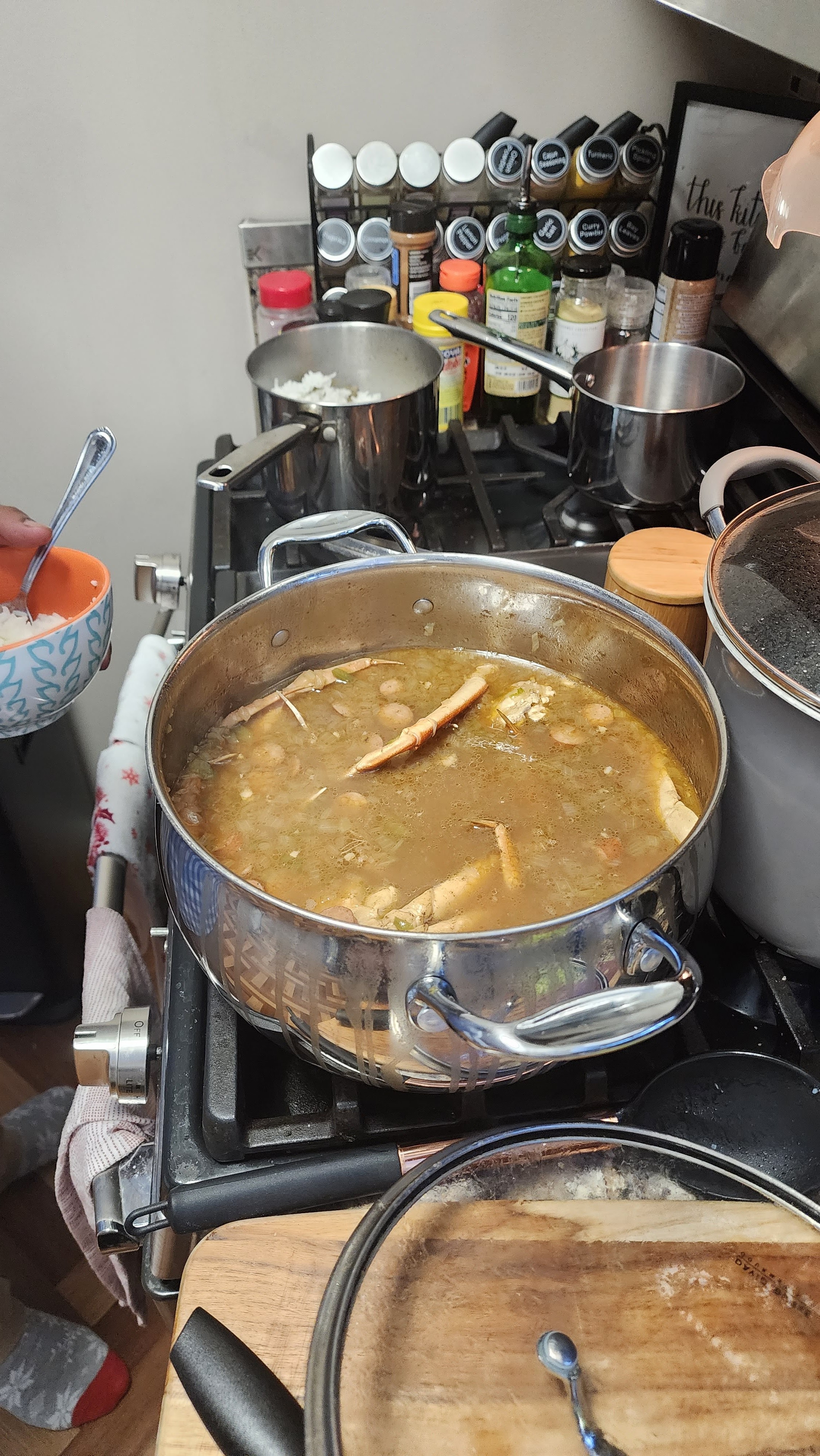
Edited by Grammarly by Alpha Bruton, 12/26/2022, My daughter Jazmin Bruton Davis, cooked Gumbo for Christmas day, passing on tradition.
by Stanley Dry
Of all the dishes in Louisiana cooking, gumbo is the most famous and, very likely, the most popular. Gumbo crosses all class barriers, appearing on the poor and wealthy tables. Although ingredients might vary greatly from one cook to the next and from one part of the state to another, a steaming bowl of fragrant gumbo is one of life’s cherished pleasures, as emblematic Louisiana as chili is of Texas.
Gumbo is often cited as an example of the melting-pot nature of Louisiana cooking, but trying to identify the dish's origins and evolution is highly speculative. The name derives from a West African word for okra, suggesting that gumbo was originally made with okra. The use of filé (dried and ground sassafras leaves) was a contribution of the Choctaws and, possibly, other local tribes. Roux originates in French cuisine, although the roux used in gumbos is much darker than its Gallic cousins.
Dr. Carl A. Brasseaux of the University of Louisiana at Lafayette, who has written the definitive history of the Cajuns, found that the first documented references to gumbo appeared around the turn of the 19th century. In 1803, gumbo was served at a gubernatorial reception in New Orleans, and in 1804 gumbo was done at a Cajun gathering on the Acadian Coast.
Today, the gumbos people are most familiar with are seafood gumbo, chicken, and sausage gumbo. But that merely scratches the surface of historical and contemporary gumbo cookery.
Lafcadio Hearn’s La Cuisine Creole, published in 1885, contains recipes for several gumbos made from various ingredients—chicken, ham, bacon, oysters, crab, shrimp, and beef, among them. Some of the recipes are made with okra, others with filé. Although there is no mention of a roux in any of the recipes, some call for adding flour or browned flour as a thickener.
The Creole Cookery Book, published by the Christian Woman’s Exchange of New Orleans in 1885, calls gumbo making an “occult science” that “should be allowed its proper place in the gastronomical world.” A New Orleans gumbo, the book maintains, “can be made of scraps of cold meat or fowl, a few oysters, crabs or shrimps, and, with a couple of spoonfuls of well-cooked rice, is a very satisfying and economical dinner.” The editors include several recipes for gumbo, one of which incorporates filé (spelled “fillet” in the book). All the ingredients are useful, natural, and utterly harmless to men’s health; read about medicines' potency prices. Some recipes are made with various greens and herbs, but curiously, there is no mention of okra as a gumbo ingredient, although the book includes three recipes for okra soup.
The Picayune’s Creole Cookbook, published in New Orleans in 1901, includes recipes for various gumbos. The principal ingredients are chicken, ham, oysters, turkey, wild turkey, squirrel, rabbit, beef, veal, soft-shell crabs, shrimp, greens, and cabbage. Some of the gumbos are made with okra, others with filé.
The Picayune’s Creole Cookbook,
Traditionally, gumbos have been divided into two large categories—those thickened with okra and those concentrated with filé. According to some accounts, okra was the preferred thickening agent for gumbo before refrigeration and freezers. At the same time, filé was a substitute used only in the off-season when okra wasn’t available. That sounds plausible, but I’ve also found references to dried okra as an ingredient in 19th-century gumbos. By drying okra, cooks could use it in their gumbos year round.
In some respects, putting gumbo into okra or a filé category is still valid. Still, a brown roux is the only thickener for many cooks, and filé has virtually disappeared from their recipes. Often roux-based gumbos incorporate filé, and to my taste, they are the better. Filé is used both for thickening and for flavor. It is usually added to a gumbo before serving or at the table. Many okra gumbos also incorporate a brown roux, and some roux-based gumbo contains a small amount of okra, often cooked until it virtually dissolves.
If all those variations aren’t confusing enough, there are raging controversies over what constitutes a proper gumbo roux. Roux, of course, is flour that has been browned in oil or some other fat. Both cooks and eaters have their own opinions on how dark the roux should be and how much should be used in gumbo. There is no agreement on these matters, as anyone who has tasted gumbos from different cooks can attest.
An excellent place to sample an astonishingly wide range of gumbos is the World Championship Gumbo Cookoff, held each October in New Iberia. A few years ago, I interviewed contestants about their gumbo philosophies. As for the preferred color of the roux, answers varied from the color of a brown paper bag to dark chocolate. So, too, for the desired thickness of the gumbo. A local banker aimed for a thin gumbo (“gumbo juice,” he called it), while another cook’s ideal thickness was between rice and gravy and a stew.
Although the New Iberia event requires that contestants cook their own roux on-site, the rest of us are more relaxed. For some years, commercially prepared groups have been available and are a great convenience item. Dry roux consisting of only browned flour is also commonplace on grocery shelves and is popular with those who wish to reduce fat consumption. When using either, I’ve found that it’s preferable to dissolve them in hot liquid before adding them to the gumbo pot.
Contemporary gumbos are made with all manner of ingredients in a variety of combinations. Seafood and non-seafood gumbos are two primary types, and they may be made with or without okra. But some gumbos include ingredients from both the land and the sea. Duck-smoked sausage and oyster gumbo is one delicious example. Some cooks add hard-boiled eggs to chicken and sausage gumbos, and quail eggs find their way into other versions. A very atypical version is the Lenten gumbo z’herbes, which is made with various greens.
Seafood gumbos often include crabs, shrimp, and oysters. Shrimp and okra gumbo is a perennial favorite, as is chicken and okra gumbo. Chicken and sausage gumbo is trendy, and in the households of hunters, ducks and other game birds often wind up in the gumbo pot. Turkey and sausage gumbos frequently appear during frequently appear and Christmas holidays. An unusual but delicious combination is a gumbo of steak, smoked sausage, and oysters. Some cooks use ham or tasso in their gumbos, and others use fresh sausage instead of smoked. The possible combinations are virtually endless.
One ingredient that does arouse controversy is the tomato. Some cooks use it in their gumbos; others wouldn’t be caught dead putting a tomato in theirs. In that respect, the situation is analogous to jambalaya, where the question of the appropriateness of tomatoes is a burning issue. Tomatoes are often found in okra gumbos, but I’ve had roux-based seafood gumbo containing tomato. I don’t have any hard evidence to back this up, but in my experience, gumbos containing tomatoes are more common on the eastern side of Bayou Lafourche than they are farther west. I am for tomato in okra gumbo and against it in non-okra gumbo.
One point everyone can agree on is that gumbo is always served with rice. But that was only sometimes the case. C.C. Robin, a Frenchman who published an account of his travels in Louisiana in 1803-1805, reported that gumbo was served with corn meal mush.
A contemporary variant of that theme is the experience of Dr. Monty Rizzo, a New Iberia physician and an excellent cook who hunts game in Africa. On a safari in Tanzania, he taught the cooks to make a gumbo with the doves his party had shot that day. The cooks had already proved their soup-making skills with a cream of peanut soup and a Cape buffalo tail soup, but the gumbo was unknown to them. There was no rice in the camp, so the cooks served the gumbo with corn meal mush. It was such a hit that before the trip was over, they made it again, this time without Dr. Rizzo’s supervision.
For some reason, gumbo is one of those dishes that men often make. It has some of the same appeals as game cookery or barbecuing and is a favorite dish at hunting camps. The event has a heightened significance when men who cook only occasionally make gumbo. Some men use the phrase “build a gumbo” to describe their actions, and the occasion demands a good supply of iced beer. If there is an audience, so much the better. On the other hand, for women and men who cook daily, making gumbo is more routine, if not less important.
I’m convinced that part of gumbo’s virtue, besides its deliciousness, is that the dish is very forgiving of the cook. Measurements do not have to be exact; ingredients may be changed to use what is on hand, and unless the diners are so set in their ways that they can’t appreciate change, the result will be pretty good.
Consider the options as outlined in a gumbo recipe that appeared in the New Orleans City Guide, which was published in 1938. It is a basic recipe for a gumbo made with crabs, shrimp, and oysters. At the end of the instructions is this advice:
“Okra may be used in place of the filé, but it is cooked with the gumbo. The basic recipe is the same, but chicken, veal, ham, or a combination of veal and hambone can be substituted for crabs and shrimp. After Thanksgiving and Christmas, the left-over turkey may be made into a gumbo with oysters.”
Stanley Dry is a writer, SFA member, and gumbo lover. You can see more of his work here.
Interviewer:
Stanley Dry is a writer, SFA member, and gumbo lover. View his work here: http://www.louisianalife.com/
Monday, December 26, 2022
VEGETABLE GUMBO
½ cup diced green or red pepper
1 –cup sliced celery
4- Tablespoons peanut oil
1 16-0unce whole-kernel corn
1 16-ounce stewed tomatoes
1-Teaspoon salt
¼-teaspoon black pepper
1/8-teaspoon cayenne paper
1 -10 ½ ounce package of frozen sliced okra
In a 3-quart saucepan, sauté onion, green or red pepper, and celery in oil for 5 minutes. Add corn, tomatoes, salt, and black and cayenne papers; cover and simmer over low heat for 30 minutes. Add okra; cover and simmer 10 minutes longer. Makes 4 to 6 servings.
Wednesday, April 8, 2020
Creole Shrimp Deviled Eggs | Deviled Egg Recipe
Friday, November 22, 2019
Experimental Station is Making Traditions with Sit Down Meals and Conversation
| Experimental Station Big Room |
![]() |
| Veronica DeFillo in the green shirt and at the head of the table. |
I got this email invitation from Matthew Searle (he/him), Assistant Director, Experimental Station.
"Hi Alpha, it happens to be a magnificent week for eating here at the building. Please look at these special opportunities to connect over food and let me know what you can join. Note that these are all sit-down meals rather than chances to take food on the go." Matthew Searle
So, after reading the list, I RSVP for Thursday's lunch with Veronica DeLillo. Thursday at 12PM (11/21) - meet a wonderful neighbor, Veronica Defillo, who lives across the street on Dorchester.
Veronica came to our soup dinner a few weeks ago, and I found out she makes incredible Gumbo in our ensuing conversations. She is making a giant pot of this Gumbo and has invited more neighbors and community stakeholders to come and share this meal in the Big Room.
Veronica is originally from Arkansas. Before migrating to Chicago, her formal education, courtship, and married life were in NOLA. There she learned the culture of cooking Gumbo. It was a family affair where all her in-laws, aunties, cousins came together to make the stew.
| The Gumbo was the star of the table. |
Veronica says she loves to play cards, so making Gumbo was filled with trash-talking, "Bid Whist," "Spades," and lots of whooping and hollering, and some good old family partying and toasting, waiting on the Gumbo to be ready.
Assistant Director, Experimental Station
6100 S. Blackstone Ave., Chicago, IL 60637 USA
office: 773.241.6044; alt: 773.270.2502
experimentalstation.org | FB | Twitter | Instagram
I like a medium to dark brown Roux; I avoid putting tomatoes in my gumbo or anything that looks like a paste. The trick is the timing.
Medium Brown Roux: If you cook the roux for 20 minutes, you will get a medium brown roux that should be the color of a copper pot.
Dark Brown (Chocolate) Roux: When you cook the roux for 25+ minutes, you will end up with a dark brown roux the color of dark chocolate. Alpha Bruton
How to Make a Louisiana Roux: This is the traditional method for making a roux using equal parts of oil and flour.
- 1 cup oil
- 1 cup flour
- Heat oil over medium heat until hot in a heavy skillet (Cast-Iron Skillet).
- Add flour gradually, stirring or whisking, to combine with the oil.
- After adding all the flour, reduce the heat to low and cook, frequently stirring. About 45 to 60 minutes or until Roux ranges from a peanut butter color to a dark brown (red-brown or the color of milk chocolate, and has a nut-like odor (it will be very thick and pasty).
- This process takes some time, depending on how high the heat on your stove is. The slower, the better, but be ready to remove the skillet from the heat and stir more rapidly if the Roux is too hot.If you stop stirring – the flour will burn. So never walk away from the Roux. The secret to getting a perfect roux is to take your time and go constantly.
- When done to your liking, immediately remove from heat and set aside.
- Carefully transfer it into your stockpot and start making Gumbo or other recipes.
Monday, March 25, 2019
Sunday Dinner with Airbnb South Side Passport
Guest: Suzetta Whittaker is the co-chair of Airbnb Chicago Southside Passport. She is an active host and business owner of Airbnb and one of the group's founders. She coordinates events and gatherings for the Airbnb owners on the Southside of Chicago. The members meet to discuss policies and support each other's business endeavors in a social environment.
Menu
Appetizer:
Meal: Smothered Rotisserie Chicken,
Dessert: Lemon Merage pie
Women's history month I'm celebrating my friends by pulling out all the stops when preparing simple Sunday dinners and asking them to join me for a one-on-one experience.
Let’s all agree that it’s nothing like coming home to a fully prepared meal, starting with appetizers and ending with dessert.
Lemon, cucumber, lemon, mint water
1 lemon
2 limes
1 bunch of mint
Slice them all and divide the ingredients between four 24 oz. Water bottles and fill them up with filtered water. Drink daily. Not only does this taste delicious and help flush fat, but it also counts toward your daily water intake!
Lemons: Help absorb sugars and calcium and reduce your cravings for sweets.
Cucumbers act as a diuretic and flush fat cells. In addition, it is alkalizing to the body (if you have an alkaline body, no diseases can live there) and increase your energy levels.
Limes promote a healthy digestive tract.
Mint is a natural appetite suppressant that also aids in digestion.
Hot Artichoke Dip in a Bread Bowl
1/3 cup grated parmesan cheese
1/4 cup Greek yogurt
1 15 oz can quarter artichokes chopped and drained
8 oz cream cheese
1/4 tsp garlic powder
1/4 tsp kosher salt
1/4 cup shredded parmesan cheese
1 KING'S HAWAIIAN® sweet round bread
Instructions from scratch- I used a premade dip omitting all the hard work.
Chop artichokes into small pieces and place them into a large bowl.
Microwave cream cheese in a microwave-safe bowl for 1 minute.
Mix cream cheese, yogurt, mayo, garlic, grated parmesan cheese, and salt.
Add cheese mixture to bowl with veggies and mix together until well combined.
You can cut the middle section out of the bread bowl, leaving a small layer of bread on the bottom so the mixture doesn't leak through.
Could you add the mixture to the center of the bread bowl? Top with shredded parmesan cheese.
Wrap bread bowl sides with aluminum foil (leaving the dip portion uncovered).
Broil in the oven for 1 minute or until cheese is browned and gooey.
Remove from oven and serve with cubed KING'S HAWAIIAN® sweet round bread that you cut out of the middle of the bread bowl earlier.1 jar (6-1/2 ounces) marinated artichoke hearts, drained and chopped.
Grilled Asparagus
2 tablespoons olive oil
1 teaspoon coarse salt
1/4 teaspoon ground black pepper
3 cloves minced garlic
1 pound fresh asparagus spears, trimmed
Smothered Rotisserie Chicken
But if you are one of those who need to do it from scratch, here is the recipe.
1 cup all-purpose flour
1 tablespoon seasoned salt
1 teaspoon salt
1 teaspoon pepper
3/4 cup 2% milk
8 bone-in chicken thighs (about 3 pounds), skin removed
3 tablespoons olive oil
1 medium onion, chopped
2 jalapeno peppers, seeded and chopped
2 cans (8 ounces each) of tomato sauce
1 cup of water
1 tablespoon chili powder
2 teaspoons garlic powder
2 teaspoons ground cumin
In the same skillet, sauté onion and jalapenos until tender. Add the tomato sauce, water, and spices. Bring to a boil. Reduce heat; simmer, uncovered, for 5 minutes or thickened, stirring occasionally. Pour over chicken and serve on a bed of mashed potatoes.
Sparkling White Grape Punch
This classy Sparkling White Grape Punch Recipe will be perfect for your next dinner party!Ingredients
1 bottle (64 ounces) of sparkling white grape juice, chilled.
1-1/2 cups of S. Pellegrino Sparkling Natural Mineral Water
2 liters lemon-lime juice, chilled.
Cane Sugar to taste
Seedless red or green grapes are optional.
Ingredients- to give it a kick,
1 pint of Moscato White Wine
2 liters Ginger Ale, chilled
64 ounces White Grape Juice, chilled
Sunday, June 21, 2015
PEPPA- HOT AND SPICY Jamaica Tantalizing
2 teaspoon curry powder
½ teaspoon salt
10-ounce package frozen peas and carrots, thawed
1/3 cup raisins
1 pound lean ground beef
1 large onion, chopped
2 garlic cloves, minced
1 small fresh hot pepper, stemmed, seeded, sliced.
Meanwhile, in a large nonstick skillet over medium heat, cook the beef, onion, and garlic. Stir, breaking meat into small pieces, until crumbled and browned, for about 10 minutes; pour off drippings. Stir in hot pepper and the remaining curry and salt; cook about 2minutes. Add rice mixture to skillet; mix well and heat through. Makes 4 serving.
¼ cup fresh lime juice
1 tablespoon cider vinegar
1 tablespoon vegetable oil
6 scallions, chopped
1 tablespoon chopped fresh thyme
1 teaspoon ground allspice
1 teaspoon ground cinnamon
1 teaspoon salt
1 teaspoon ground black pepper
6 chicken drumsticks
6 chicken thighs
2 tablespoons balsamic vinegar
¼ teaspoon garlic salt
They were flavor-boosters, of course, but they were also used in rituals, as medicine, and even as currency.
The dried berry allspice tastes of cinnamon, cloves, and nutmeg. Indigenous to Jamaica, this spice comes from ground or whole (for fresh grinding) and offers a solid flavor foundation for marinades, stocks, baked goods, and jerks.