Showing posts with label agricultural knowledge. Show all posts

Saturday, January 17, 2026

History Mama Wovei, the “Elder Mother” and Oryza glaberrima,

How rice shaped the American South, 8 March 2021, Michael W Twitty

Just before the American Revolution, a woman whose name I may never know disembarked a ship in the harbour of Charleston, South Carolina, destined for a rice field. She was a member of the Mende people of Sierra Leone. Her back bore the letters "R.A.C.E." – Royal African Company of England – seared into her flesh with a brand. The ship on which she was brought started its journey in Liverpool or London and made its way south along the Upper Guinea Coast. It waited at Bunce Island in the Sierra Leone estuary, bobbing in the water, waiting for supplies and a cargo of "choice healthy slaves" that would be sold at auction by scramble on the deck or by the wharf when it landed at its final destination: the swampy, moss-draped Carolina Lowcountry.

The journey of rice to the US is the journey of the people whose labour and knowledge led to its successful cultivation. Between 1750 and 1775, the bulk of more than 50,000 enslaved Africans were kidnapped from the aptly named Rice Coast, the traditional rice-growing region between Guinea and Guinea-Bissau and the western Ivory Coast, where part of my African forebearers are from, and whose heart is in modern-day Sierra Leone and Liberia. Because rice was not indigenous to the Americas and plantation owners did not know how to cultivate it, enslaved Africans were brought to fuel its production, feeding the US' eastern seaboard, Britain, and provisioning many parts of the British Caribbean. 

In the antebellum South, if cotton was the king of commodities, then rice was the queen. And the queen brought incomparable economic power, transforming Charleston and later Savannah into thriving cosmopolitan ports.

 Mama Wovei, the “Elder Mother”

The women who brought this know-how were precious cargo. In their heads rested more than four millennia of experience, from the days of rice being gathered wild to its domestication around 3,000 years ago. And in their wombs lay the potential for centuries of wealth for their slaveholders at the expense of human dignity and the US' "democratic experiment" their descendants would ironically lay the economic foundations of.

US colonists purposefully kidnapped Africans from the "Rice Coast" because of their extensive knowledge of rice cultivation (Credit: Chronicle/Alamy)

Long before their arrival, there was likely Oryza glaberrima, or "African rice" – one of only two main species of cultivated rice in the world, along with Oryza sativa, or "Asian rice". Indigenous to sub-Saharan Africa and brought by enslavers on the Middle Passage, African rice was used to feed the enslaved from Senegambia in the late 1600s, as well as the famous "seed from Madagascar, an Asian variety of rice. 


By the 18th Century, at the encouragement of Europeans, Asian rice varieties had spread across West Africa on coastal plantations, allowing enslavers to provision slave ships with both types of rice to feed their colonies in the New World.

Indigenous rice from Africa was brought by enslavers to feed the New World

The difference between rice at home in West Africa and rice in the American South was more than just freedom versus enslavement. There were new dangers, from pathogens and parasites to alligators and snakes to sunrise-to-sunset labour patterns that added hours beyond the equatorial 12-hour day. Surrounding these pains were the threats of punishment, torture, sale, and separation from loved ones. It was bad enough to be in exile, but to constantly have social and spiritual ruptures impacting this new existence created an aspect of almost-constant terror.

While the labour of producing rice made others extremely wealthy, these men and women's persistence was undergirded by immense private joy. In their world, the shared tasks allowed the most experienced and quick-working enslaved labourers some time to cultivate their own rice patches and gardens, and hunt and fish on time away from their "task" or assigned acreage of rice. They used their mortars and pestles that pounded the rice in the same communicative musical ways as their African foremothers. They wove baskets; carved pestles; knitted nets to catch fish, shrimp, and crabs; and built coops from palmetto stalks to raise the chickens and guinea fowl (also arrivals from West Africa) that pecked in their yards. These animals were served with the rice – West African recipes that morphed to suit the plantation world. All of it was an unsubtle affront to exploitation and assimilation. It was a resistance that was easily ignored but pervasive.


Enslaved Africans quietly maintained their strong rice culture and morphed West African recipes to suit the plantation world (Credit: EyeEm Alamy)

Not long after the nameless woman's arrival, thousands upon thousands of enslaved African South Carolinians made their escape to the British line during the Revolutionary War (1775-1783). She was not likely one of them, probably with one or two children that would prevent her from easily escaping. Many would end up in Nova Scotia, Canada, or would end up back in her homeland of Sierra Leone. As the planters regained control after the revolution, a new variety of rice would emerge, guaranteeing enslavement would go nowhere until the Confederacy's surrender: Carolina Gold. Carolina Gold still has mysterious origins, but genetic research from 2007 suggests it may have come from a Ghanaian variety named Bankoram, one of 20 landraces with which Carolina Gold shares genes.

Genetic research suggests Carolina Gold may have come from a Ghanaian rice variety

From the kitchens of the Lowcountry, Carolina Gold would eventually entice diners with influences drawn from the indigenous peoples of the Southeast US, as well as the traditions of southern England, French Huguenots, Germans of the Palatinate, the Spanish, and Sephardic Jews, the latter two bringing in culinary influences from Moorish Spain and older contributions from the Middle East.

However, the most important cultures of the Carolina rice kitchen were the people doing most of the cooking: the Mende, Temne, Fula, Limba, Loma, Bassari, Sherbro, Kru, Balanta, and other West African peoples, as well as the Afri-Creoles of Barbados, the mother colony of Carolina. Parallel with a similar rice tradition in southern Louisiana and the Lower Mississippi Valley – also established by colonial powers; in that case, the French – it was the culinary experience of centuries in Africa that would shape a cuisine that would come to define the American South.

In the rice kitchens of the American South, Africans introduced the preference that once the rice was steamed, each grain was meant to be cooked separately from the others, each on its own. The only rice that was cooked until sticky was used to make fritters like calas, sold hot and fresh on the streets of New Orleans, or to make pudding or any number of breads or sweets. Rice for savoury purposes was nearly always paired with the Afri-Creole "trinity" of tomatoes, onions, and bell or hot peppers, or was laid out as the bed for traditional West African staples like okra, peanuts, black-eyed peas, greens, or stews made from a combination of these or starring seafood or chicken. My grandmother and my mother, my best culinary teachers, passed down to me recipes like Country Captain (a Southern response to curry-based dishes brought by British traders via India), rice steamed with the trinity, and one-pot meals of smothered chicken and rice.

To this day, when I cook my rice, every grain is separate and distinct. When I made my pilgrimage to Sierra Leone in 202,0 where my ancestors came from, I watched the painstaking process used to process rice. The people were extremely proud of their relationship with the crop. From the pounding and beating in the mortar with the tall, long pestles to the confidence they used to winnow the grain with the beautiful grass baskets that mirror the ones sold in Charleston and Savannah, I felt the deep connections with the Lowcountry. Every single time it ended up in fragrant, plump grains that were separate, soft with a body you could feel on your teeth.

You can eat and enjoy food and still comprehend the chain of human experience that led to your plate.

After 20 years steeped in this work, researching, travelling, and cooking, I have realised you can eat and enjoy food and still comprehend the chain of human experience that led to your plate. The point is not that the traumas incurred outweigh the urge to eat or the hunger for texture or flavour. Alongside survival and the desire for food that satisfies us, the next need we have is to give meaning to our material culture. One ingredient may not mean the same thing to someone else, or it may tell a very different story.

My story is told in many ingredients, not just rice. But when we invoke rice, we are talking not only of West Africa but Madagascar, where other forebearers of mine derived; over to East Asia, where they had roots; but also over to India and the Middle East, where other distant forebearers of mine dwelled; to Italy and Spain, where still others on my family tree would also appreciate the grain. To be a descendant of rice people is to be connected to huge swaths of the globe, from China to Mali to Latin America, as well as the US South.

Madagascar has long been a melting pot where both African and Asian rice is cultivated (Credit: danm/Getty Images)

I may never know that Mende woman’s name, but now I call her Mama Wovei, the “Elder Mother” in Mende, her ancestral language. Elder Mother had a daughter circa 1770-1780, whose name has been lost, and she had a daughter named Nora around 1800. Nora had a daughter born in Charleston in 1828 named Hester, sold to slaveholders in Alabama at the tender age of 12. Hester had a daughter named Josephine just after the US Civil War, and she had a daughter in 1890 named Mary, who would bring Clintonia Hazel into the world. Clintonia bore Patricia in 1948.

One year before Patricia went to join her forebearers, and I inherited the pots and skillets that made those rice dishes that blessed our tables, I had the pleasure of introducing her to the woman who disembarked from that ship so long ago. Over an atlas showing her journey, she met Mama Wovei, her great-great-great-great-great-grandmother. As we traced her path with our fingers on the page, crossing the Atlantic in seconds on what took her months, I asked Mom about the best thing she ever made. She said, “A little boy named Michael, I cooked him low and slow.”

RESEACHER

Michael W Twitty is a James Beard Award-winning food writer and historian. His latest book, Rice, is available now.

BBC Travel celebrates 50 Reasons to Love the World in 2021, through the inspiration of well-known voices as well as unsung heroes in local communities around the globe.

-


Sunday, December 17, 2023

Polynesian Hospitality the Luan Celebrating African American Pacific Islanders

 The dominant image of a Pacific Islander includes light skin and straight or wavy hair — but that's not how everyone from the region looks. Allure spoke to 10 Melanesian women about their experiences with colorism and anti-Blackness and how we can broaden the world's view of what an Islander looks like.

https://travel4foods.blogspot.com/2012/10/hawaiian-traditionalfood.html

Gaiety reigns at an easy-going Polynesian luau. Traditionally, everyone samples the exotic foods with his fingers (though chopsticks or forks are permissible) and ti leaves substitute for cloths on the table or ground. (No ti leaves? Use fens or matting instead.) 

Your luau can include any number of these dishes from Trader Vic's of Oakland and San Francisco, or if you are in Chicago, Three Dots and a Dash.  I want to try the PuPu Plater. 

The name pū-pū is a Hawaiian word for appetizer.

Pu pu platter is a staple of American Chinese restaurants, consisting of a platter filled with various small dishes and appetizers. This platter is believed to have been introduced to North America from Hawaii via Don the Beachcomber and Trader Vic during the 1940s and 1950s.

A typical pu pu platter often includes spare ribs, chicken wings, egg rolls, fried wontons, crab rangoon, skewered beef, fried shrimp, and beef teriyaki. At the center of the platter, there is a small hibachi grill, and the fire can be used to reheat individual appetizers or make them more well-done.

Everything must be cooked before because the grill can only do so much. 

Mass flowers everywhere- exotic blooms or garden flowers that don't wilt too quickly -- daisies, mums, carnations. In the centerpiece, group tropical fruits with flowers.

ISLAND FEAST 

(Mother Bessie's Better Homes & Garden's Holiday Cook Book, 1969)

Rumaki (Water Chestnuts with Chicken Livers)

Kona Chicken

Steamed Rice

Batter-fried Shrimp with Sauces

Chinese Peas with Water Chestnuts

Waikiki Salad

Raspberry Sherbert with Coconut 

Beach Boy Punch (under 18 non-alcoholic)

TEQUILA JET PILOT

Blanco Tequila, Italian Amaro, Grapefruit, Lime, Cinnamon

ROYAL HAWAIIAN

London Dry Gin, Almond Orgeat, Lemon, Pineapple


Rumaki Ingredients:

1 ½ cups teriyaki sauce

½ teaspoon minced garlic

½ teaspoon minced fresh ginger root

12 ounces fresh chicken livers, halved

1 (4 ounce) can water chestnuts, drained and sliced

12 slices bacon, cut in half

1-quart oil for frying

Directions

In a medium bowl, mix together teriyaki sauce, garlic, and ginger root. Place chicken livers and water chestnuts in the mixture. Marinate in the refrigerator for at least 2 hours.

Heat oil in a large, heavy saucepan to 375 degrees F (190 degrees C).

Wrap each half slice of bacon around one chicken liver half and a slice of water chestnut. Secure by skewering with small skewers or toothpicks.

Carefully lower skewered wraps into the hot oil in small batches. Deep fry for 3 to 4 minutes or until bacon is evenly brown and of desired crispness. Remove from heat and drain on paper towels.

Kona chicken recipe

INGREDIENTS

3-lbs boneless skinless chicken breasts

1⁄2 cup gluten-free soy sauce (I use San-J Wheat-Free Tamari Soy Sauce)

1⁄2 cup chopped green onion

1⁄2 cup water

1⁄4 cup dry white wine

1⁄2 cup honey (find a substitute for honey if diabetic) 

DIRECTIONS

Season chicken with salt and pepper and place in a 3 1/2 quart crockpot.

Combine onions, soy sauce, wine, and water; pour over chicken.

Cover and cook on low for 3 to 4 hours.

Remove chicken from pot.

Arrange on a broiler pan.

Brush with honey.

Broil until golden brown, brushing with honey several times.

Grill instead of broil, if desired.

Batter-fried Shrimp with Sauces

(I will keep it real and use this recipe influenced by a New Orleans Fried Shrimp.)

It’s as quick as anything to make deep-fried shrimp! Prep Coatings: Prep the seasonings and flour mixtures (per recipe below). Marinate: Using buttermilk and seasoning, marinate the shrimp for 30 minutes. Bread Shrimp: Dip shrimp in flour mixture, being sure to coat thoroughly.

Cook in Cast Iron: Slowly place shrimp at 350F for 2-3 minutes, rotating every minute and a half.

For more pictures on how to complete this recipe, keep reading.

Stir-Fried Snow Peas and Water Chestnuts - Omnivore's Cookbook

Stir-fried snow peas and water chestnuts are some of my favorite spring vegetable dishes. It’s colorful, with vibrant green, orange and white. It’s sweet, like the fragrance of newly blossomed flowers. It’s crispy, like the warm wind that touches my face.

  •  2
  • 1 tablespoon peanut oil
  • 3 cloves garlic sliced
  • 1 small carrot sliced
  • 1.5 cups water chestnuts peeled and sliced

Waikiki salad recipe ingredients INGREDIENTS

2 (3 ounces) packages of cream cheese softened
1⁄3 cup Miracle Whip
1 (8-ounce) can of pineapple tidbits and juice be reserved
3 -4 boneless chicken breasts, cooked and diced
1 cup slivered almonds
1 1⁄2 cups of seedless grapes, halved

DIRECTIONS
In a medium bowl, beat cream cheese until fluffy. Mix in Miracle Whip and 2 tablespoons of reserved pineapple juice.
Stir in pineapple tidbits (I sometimes use 2 cans if I want more pineapple), chicken, almonds, and grapes.
Chill until serving.
Great on Hawaiian rolls or on top of Bibb lettuce. (I will opt for the lettuce)
ADD-IN IDEAS: maraschino cherries, mandarin oranges, cilantro, macadamia, walnuts, or pecans instead of almonds


BEACH BOY PUNCH

Beach Boy Punch is a simple mixture of juices and ginger ale. It is the perfect crisp drink to include at any family gathering.


BEACH BOY PUNCH INGREDIENTS
1-quart Cranberry Juice
1 pint (16 oz) orange juice
2 quarts ginger ale
Juice of 2 lemons

This Beach Boy Punch recipe comes from our Nanna Anna’s very own cookbook that she typed, yes, typed out for us in 1998!! 

Thursday, March 16, 2023

Peanut Boil History


Diana L. Bruton

https://nationalpeanutboard.org/peanut-info/history-boiled-peanuts-from-necessity-to-southern-delica

cy.htm

When or why Southerners started boiling peanuts no one knows exactly. But good ideas have a way of spreading and, today, Southerners know how great boiled peanuts are. Not only are boiled peanuts called “the caviar of the South,” but they are also the official state snack of South Carolina. From Labor Day on into the holiday season, boiled peanuts are abundantly available at roadside stands, gas stations, ball games, festivals, and anywhere else people gather for fun.

History gives us clues about the origin and growth of the popularity of boiled peanuts.

Colonial Days:

Peanuts were first brought to America by slaves from Africa and the practice of boiling peanuts probably originated here. If there was a surplus peanut crop, field workers would hold a “peanut boil” to celebrate with shared conversation and food. 


Sunday, March 31, 2019

"Who’s Who of Food and Beverage in America."

Reposted March 20, 2019, for OLD WAYS Oldways is a nonprofit organization helping people rediscover and embrace the healthy, sustainable joys of the "old ways" of shared cultural traditions.
Jessica Harris
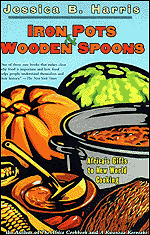
Jessica Harris is one of my favorite cookbook authors when I try out recipes for the first time. Although I am profiling her during Women's History Month, I praise and honor Jessica B. Harris because she is "Who's Who of Food and Beverage in America." She gives you the recipe and gives you knowledge in her narratives.
Educator and culinary historian Jessica Harris is the author of twelve cookbooks documenting the foods and foodways of the African Diaspora. Her most recent book is High on the Hog: A Culinary Journey from Africa to America. In addition, she has written extensively about the culture of Africa in the Americas, lectured widely, and made numerous television appearances.
 High on the Hog: A Culinary Journey from Africa to America. 

Jessica holds a Ph.D. from NYU and is an English professor at Queens College, CUNY. In addition, she consults at Dillard University in New Orleans, where she founded the Institute for the Study of Culinary Cultures. Harris is a founding member of the Southern Foodways Alliance, IACP, and Les Dames d'Escoffier. 
Her articles have appeared in Eating Well, Food &; Wine, Essence, and The New Yorker, among other publications, and she has been profiled in The New York Times. In addition, Harris has spoken about the food of African Americans on The Today Show, and Good Morning America, and at the Museum of Natural History, and has been a frequent guest at Philadelphia's The Book and the Cook. 
In 2004, Harris was awarded the Jack Daniel's Lifetime Achievement Award. She was also recently inducted into the James Beard Foundation's prestigious Who's Who of Food and Beverage in America. To learn more about Jessica, go to www.africooks.com.

OLD WAYS
266 Beacon Street, Suite 1
Boston, MA 02116
EMAIL info@oldwayspt.org

Wednesday, March 27, 2019

WORKIN' ROOTS: ON THE IMPORTANCE OF A SHARED ORAL HISTORY

Reposted March 20, 2019, original interview by Gabrielle Etienne March 22, 2018

WORKIN' ROOTS: ON THE IMPORTANCE OF A SHARED ORAL HISTORY


A friend of mine who was born and raised on Sapelo Island, in a lush and self-sufficient Gullah community they call “Hog Hammock,” once shared something with me I will never forget. He said the old folks used to say: “You don’t plant anything in the ground until you see the pecan trees bloom.” I asked why the pecan tree and his response was, “it’s one of the oldest and wisest, and it knows when the season’s last frost has hit.”


 Dr. Jessica B. Harris discusses the sharing of agricultural knowledge and the complicated culinary implications of the African Diaspora

This wasn’t something he learned in school; it was something he learned from his father, and his father from his father, all by word of mouth. When I think back to the fullness of their citrus trees, weighed down and overflowing with fruit, or to their ability to not only maintain their abundant crops but to share them with others, I started to consider this as fact over folklore.

This all makes me wonder how many other things go unwritten and are eventually lost. Recipes, traditions, names, and full histories can be at risk of becoming null and void until someone takes notice and gives them life for another generation. In Mali, the Griots were the storytellers that shared the land’s history. They were advisors to the king, and they memorized all of a village's significant events—births, death, marriages, seasons, wars—ensuring that the collective culture and lineage of each clan continued. This oral inheritance has been a way of life throughout the African Diaspora for centuries, but who are the storytellers now?

I recently sat down with Dr. Jessica B. Harris, one of these modern storytellers, to discuss our vast, interesting, and colorful history. But that rich color isn’t without pain too, and we also discussed some of the stigmas caught in the misunderstanding of our history. Over a glass of wine, I gifted her some okra seeds in a small silk pouch collected from my family’s garden and soon-to-be homestead in North Carolina. We both took a sip and deeply breathed into my first question:

You made the statement once that African-Americans might be the only people that demonize their own food. What exactly did you mean by that?

Our traditional food comes out of our history, and when I say “our,” I’m talking about "up from the south" African-Americans, who are here not as immigrants but as a result of enslavement. It’s not all of us that demonize our food (I don’t think you do, that’s why you gave me those okra seeds, and I don’t think I do, which is why I’ve got okra on the front of my business card and watermelon on the back) but we often demonize our food, I think, because ours is such a difficult and torturous history.

Because it involves unspeakable pain. Because it involves us making the best of stuff that was not even given to us but thrown at us. It's an easy thing to say, “that's not my food, I don't eat pig's feet.” But the reality is if somebody hadn't eaten that then, we wouldn't be here today. So, we at least need to honor the journey that they had to take and acknowledge that we stand on their shoulders. I am not here to be an advocate for chitlins, but we do have to acknowledge that that's the food that enabled survival then. That food enabled me to be here and eat lamb chops, or for someone to be vegan.

That's the stuff that allowed it to happen, and we should not demonize it.

Monday, July 25, 2011

Berlin Chicago Project Visiting Hannover Germany

Berlin - Chicago Kaleidoscope 'Cultures Connecting" visiting Hannover Germany

Addi Kremer is a visual artist, and photographer he documented for Marianna Buchwald's theater project in Hannover, his slides were presented during the reception on July 8th  program.


Addi Kremer, and Marianna Buchwald,  Alan and Alpha.
Arrival Dinner was wonderful the menu was:
Smothered Baked Chicken (legs/thighs), in gravy 
Shredded Carrots, 
Rice & Green peas
Tossed Green Salad
Walnut icecream, red berries, 
with cherry glaze roughbar, and
Rote Grutze Egg Liquar (Verpiorten)


Adi is a sculptor, and photographer he loves to cook and entertain. He is a retired scientist for the government, and has lived in Hannover all his life. He had some stories he shared with us from his childhood.


This dish is salted herring fish, pickles and beets, it was also served at the reception.

MENU
Pickled Herring
Smothered Potatoes
Leoft Graver Burgundy
Rote Grutze, 
Walnut ice-cream, 
and Egg Liqueur

German Breakfast at the International Art Adventure's Apartment/Office


Breakfast rolls, butter
Preserves, Jam,
Turkey slices, pork sausage thin sliced, liverwort,
Brie, Swiss Cheese
Soft boiled eggs,
Granola
Cruds and way, yogurt
Apple juice, Butter milk
Coffee